Brief History of Monte Sano
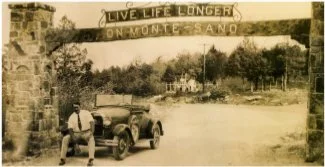
Monte Sano is Huntsville’s unique mountain community. Actually, we’re not a mountain, but a plateau, and we are 1,000 feet above Huntsville. Thanks to our own Internet website and several mountaineer Facebook sites, the 600+ mountain families are practically “next-door” neighbors. Here is a brief history of Monte Sano:
Early History - Between 65 and 150 million years ago, our entire region was under water. When the water receded, much of the marine life was left to fossilize and is visible today in the rock formations along some hiking trails in the adjacent Monte Sano State Park.
Indians did not live on the mountain, however, arrowheads have been found, indicating they hunted game here. The first landowner was Charles Cabiness, who obtained an 80-acre tract in 1809 (Huntsville was not incorporated until 1811). In 1816 Thomas Martin built a home near Cold Spring, which included, allegedly, the first indoor bathtub in the United States. He piped the spring’s waters into his house through hollow cedar logs into a limestone tub.
Legend has it that Dr. Thomas Fearn brought a sick child to Monte Sano in the 1820s after all other treatments had failed. A few weeks of residence produced a cure and earned for the mountain the name of Monte Sano, Spanish for “mountain of health.” The mountain soon became a refuge for people afflicted with yellow fever, cholera, and malaria, who sought out its cool air and clear spring waters.
In 1829 Rev. James Rowe and his wife Malinda Poff Rowe established the Monte Sano Female Seminary in three buildings on the north end of the mountain. The school was successful. One of their students road a mule to class from Gurley. The Rowes had two sons. But Malinda suffered from chronic rheumatism, which eventually caused her death in 1833 and she was buried at the site of their home and school. After that, Rev. Rowe closed the school and moved away. Union soldiers burned the school buildings during the Civil War.
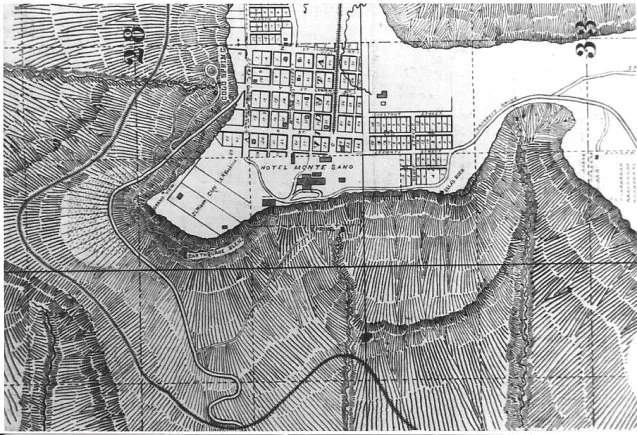
Viduta Village
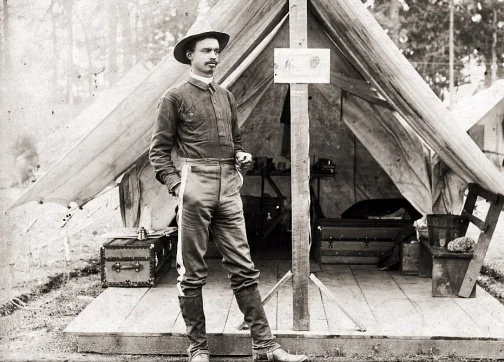
Camp Monte Sano, 1888—1898
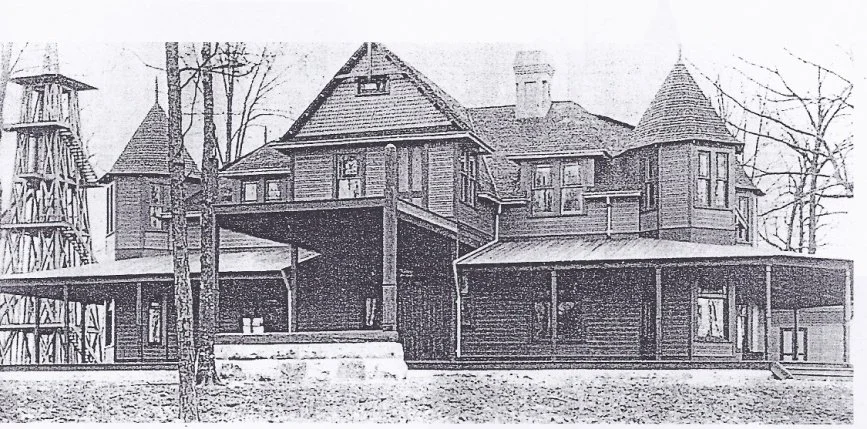
The O’Shaughnessy Home
Dr. Thomas Fearn and his brother George planned a colony for people seeking relief from illness. Thomas Fearn built an ornate home for himself and his family, complete with stables and a smokehouse. By 1833 an inn had been established. They laid out 67 lots, separated by streets and avenues. Three acres around Cold Spring were set aside as a park. By the end of the year, 38 lots were sold. The town was named Viduta, meaning “view” in Italian. Houses were erected along the streets. Residents included a military general, a judge, a banker, a state senator, and a future Confederate congressman. But it soon came to an end during an economic recession, and Union soldiers destroyed much what was left of the colony during the Civil War.
With the fast-moving 1890s, prosperity returned to the mountain. Colonel James O’Shaughnessy came to Huntsville to supervise construction of a railroad line from Brunswick, Georgia, to St. Louis, Missouri, that would pass thru Huntsville. O’Shaughnessy bought an estate on Monte Sano, but it was destroyed by fire. He soon built another—a large home in what later became the State Park. O’Shaughnessy also played a leading role in the construction of a 223-room bluff-side hotel in 1887. A railway to the hotel competed with stage coaches for the fares of tourists bound for cooler climate. The United States Surgeon General declared that Monte Sano was the “second healthiest spot in the U.S.” (No word on who was first.) This declaration was a real estate agent’s dream come true. Prosperity was here.
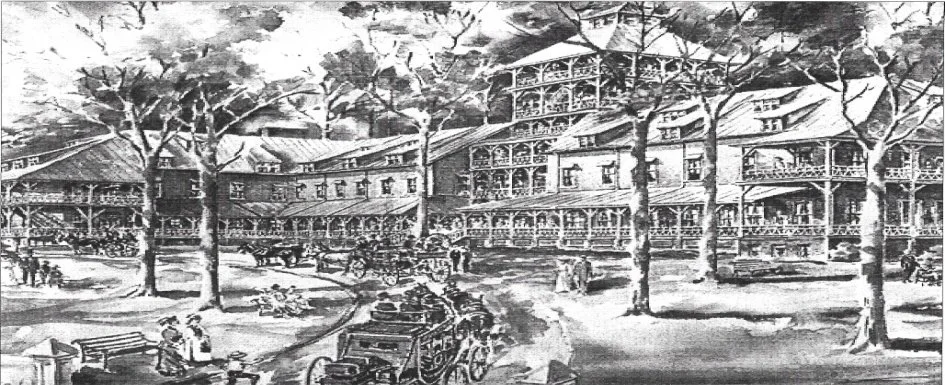
The Monte Sano Hotel
A week's stay at Hotel Monte Sano, a three-story Queen Anne–style luxury health resort, cost $11 and included amusements such as bowling, horseback riding, croquet, lawn tennis, and horse-drawn carriage rides to three of the healthful mineral springs on the mountain. The Hotel, located on present-day Old Chimney Road, drew well-to-do clientele from around the country, especially Memphis, St. Louis, and Chicago. But then it evaporated. The mountain railroad was deemed too hazardous to attract passengers, so the line failed. Lacking railroad transportation, the hotel’s business dwindled. Also, the 19th-century tradition of sending ailing patients to retreats on the mountain declined with the development of vaccines and treatments, which ended the era of health trips to the mountain. Finally after the 1900 summer season, the gala days of the hotel came to an end. The hotel was eventually dismantled and some of the materials reused in the post-World War II housing boom.
Camp Monte Sano – Each summer, more than 200 soldiers were sent here from Ft. Barancas (Pensacola), Florida, 1888 to 1898, to recuperate from yellow fever and malaria. The camp encompassed approximately 20 acres and included a hospital. Its boundaries were from Monte Sano Blvd., west on Panorama Dr. and Hutchens Ave., to Crescent Circle.
The CCC’s Monte Sano Lodge
Boom days of the late 1920s saw another spurt in mountain-top activity. In 1926 a new highway was built over the mountain’s lower south end with a spur up to our plateau. A company called Monte Sano Construction Company laid out lots within the west half of today’s Panorama Drive. The foundation was dug for a new hotel to be called Monte Sano Manor, located on the bluff-side of today’s Thompson Circle. Regular bus service was arranged and an extensive advertising campaign was launched. But work on the hotel was halted after a single day’s work. The New York Stock Market had crashed. Land prices skidded. The Great Depression had begun.
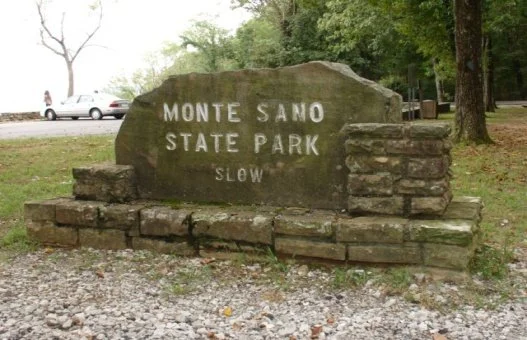
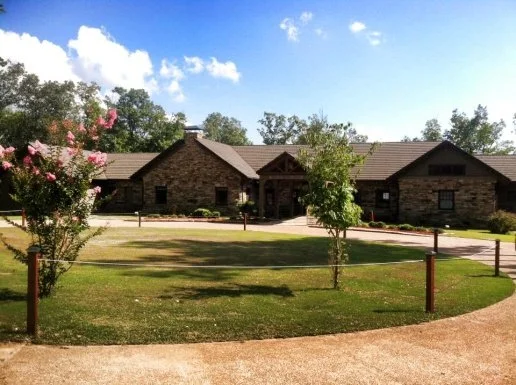
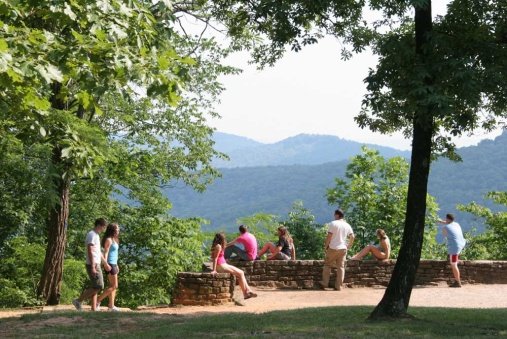
Scenes from Monte Sano State Park
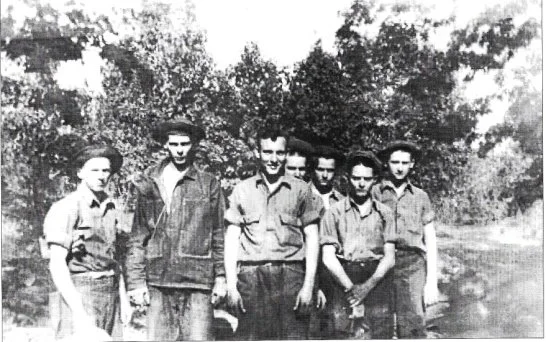
Some of Monte Sano’s CCC boys
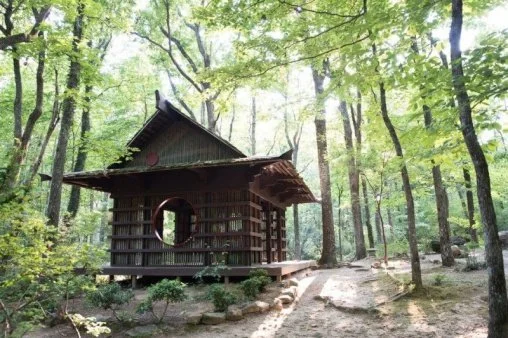
Monte Sano’s CCC Camps – the Civilian Conservation Corps – was a voluntary public work-relief program of the Franklin Roosevelt administration that operated during the Great Depression from 1933 to 1942. It was for unemployed, unmarried men ages 18–25. There were 2,600 camps located across the nation. Huntsville had three of them, and two were located on Monte Sano at the east end of today’s Highland Plaza. The rock entrance to the camps, with a historical marker, are on Monte Sano Boulevard at Highland Plaza. CCC workers developed Monte Sano State Park, constructing an amphitheater, lodge, a horse barn, roadways, hiking trails, picnic areas with scenic overlooks, modern campsites, and rustic cottages built in the Arts and Crafts style. The park officially opened on August 25, 1938. Today, Monte Sano State Park, along with the adjacent Land Trust area, features nearly 40 miles of hiking trails and 14 miles of mountain biking trails. In addition, The Von Braun Astronomical Society runs the planetarium and observatory in the park.
Recent History - Monte Sano was annexed into the City of Huntsville in 1956. This brought paved streets, improved water service, a fire station, and a significant building boom to meet the needs of Huntsville’s “Rocket Age.” Soon the mountain became the home to a number of German “rocket scientists” who likened it to their Bavarian homeland. The school was completed in 1959 and a community swimming pool opened three years later. Television stations also began broadcasting from the mountain.
This document was compiled by John H. Allen from sources by Jimmy Hill, Jane Barr, and Joe Cuhaj, in November 2021. For more history of Monte Sano, see Jimmy Hill’s History of Monte Sano, or simply Google “Jimmy Hill’s History of Monte Sano.” Also, Jane Barr compiled some two-dozen booklets on Monte Sano history (a copy of each resides in the Special Collections Department of the Huntsville-Madison County Public Library). The UAH Salmon Library’s Archives and Special Collections Department has an impressive collection of Monte Sano historical paraphernalia, which is accessible to the public. Thanks to Ruth Bentley for editing this document.